


TMS Therapy for OCD
in Houston, TX
For OCD that has not responded adequately to medication, exposure and response prevention (ERP) or both. Deep TMS targets the frontal circuitry implicated in OCD, and we deliver it with the individualized symptom-provocation protocol used in the trial behind FDA clearance.
We Verify Benefits & Send a Written Estimate
30+ Years of Clinical Leadership
TMS, Ketamine & Therapy, Coordinated Into One Plan
Proven Protocols, Tracked Outcomes
Is TMS for OCD right for you?
TMS therapy for OCD is for individuals whose symptoms remain clinically significant after an adequate trial of first-line treatment. It is an adjunctive treatment: it is added to your current care and does not replace it.
It may be a good fit if you:
✓ Have had an inadequate response to a serotonin reuptake inhibitor (an SSRI or clomipramine), to exposure and response prevention (ERP), or to both
✓ Want an option that doesn't add another medication
✓ Can attend sessions five days a week for about six weeks
Your evaluation screens for contraindications, including:
⚠︎ Ferromagnetic or electronic implants in or near the head, such as aneurysm clips, cochlear implants or deep brain stimulators
⚠︎ A seizure disorder, or medications and conditions that lower the seizure threshold
Not sure? Your evaluation answers this. A psychiatric provider confirms the diagnosis, reviews your treatment history and tells you plainly whether TMS is indicated.
What is TMS for OCD, and how does it work?
Transcranial magnetic stimulation (TMS) uses rapidly alternating magnetic fields, delivered through a coil held against the scalp, to induce small electrical currents in targeted brain tissue and modulate activity in the circuits that tissue belongs to. It is non-invasive: there is no surgery, anesthesia or sedation. You stay awake, drive yourself home and return to work or school the same day.
The leading model of OCD implicates cortico-striato-thalamo-cortical (CSTC) circuits, loops that connect the frontal cortex with the striatum and thalamus. Two regions in these loops matter most here: the medial prefrontal cortex and the anterior cingulate cortex. The anterior cingulate is central to error and conflict monitoring; it generates the signal that something is wrong and needs correcting. Neuroimaging studies show these regions are hyperactive in OCD at rest, and more so during symptom provocation.
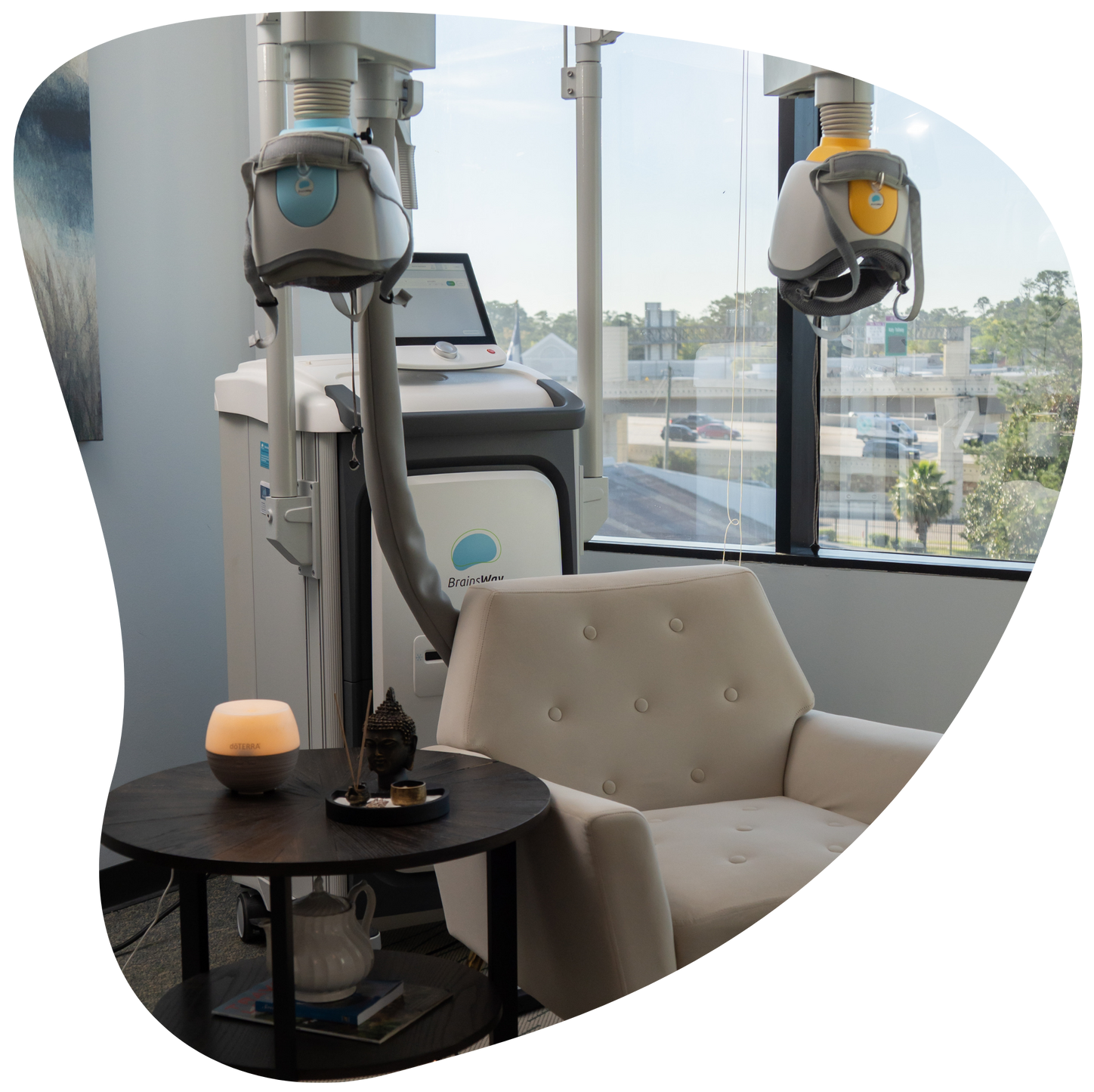
The figure-8 coils typically used for depression stimulate a focal area of the dorsolateral prefrontal cortex near the surface of the brain. The H7 coil used in Deep TMS for OCD produces a broader, deeper field designed to reach the medial prefrontal and anterior cingulate cortices along the midline.
Transcranial magnetic stimulation (TMS) uses rapidly alternating magnetic fields, delivered through a coil held against the scalp, to induce small electrical currents in targeted brain tissue and modulate activity in the circuits that tissue belongs to.
It is non-invasive: there is no surgery, anesthesia or sedation. You stay awake, drive yourself home and return to work or school the same day.
The leading model of OCD implicates cortico-striato-thalamo-cortical (CSTC) circuits, loops that connect the frontal cortex with the striatum and thalamus. Two regions in these loops matter most here: the medial prefrontal cortex and the anterior cingulate cortex. The anterior cingulate is central to error and conflict monitoring; it generates the signal that something is wrong and needs correcting. Neuroimaging studies show these regions are hyperactive in OCD at rest, and more so during symptom provocation.
The figure-8 coils typically used for depression stimulate a focal area of the dorsolateral prefrontal cortex near the surface of the brain. The H7 coil used in Deep TMS for OCD produces a broader, deeper field designed to reach the medial prefrontal and anterior cingulate cortices along the midline.
We use the full protocol, including symptom provocation
In the pivotal trial behind FDA clearance, every session began with a brief, individualized symptom provocation. We follow the same protocol at every visit.
Build a symptom hierarchy
At the start of treatment, you and your clinician build a ranked list of your specific obsessions and triggers.
Provoke symptoms briefly
Before each session, a trained staff member guides you through one trigger for a few minutes. The target is moderate distress, roughly 4 to 7 on a 10-point scale, not overwhelming anxiety.
Stimulate the activated circuit
You hold those thoughts in mind as stimulation begins, so the circuit is engaged while it is being stimulated.
The rationale is state dependence: how a circuit responds to TMS depends on its activity at the moment of stimulation. A 2025 systematic review and meta-analysis in JAMA Psychiatry (63 studies, 2,998 participants) found active TMS superior to sham for OCD both with symptom provocation (standardized mean difference −0.51) and without it (−0.29). The effect was numerically larger with provocation, but the difference between the two was not statistically significant and comes from comparing separate studies, not a head-to-head trial.
What we can say with confidence: the protocol the FDA cleared includes provocation, and the efficacy data behind that clearance came from sessions that used it every time. A course that omits it is not the course that was studied. If you are comparing providers, ask whether they do it.
Does TMS work for OCD? What the trials found
The pivotal trial (Carmi et al., American Journal of Psychiatry, 2019) was a multicenter, randomized, double-blind, sham-controlled study of 99 adults at 11 sites whose OCD had not responded adequately to medication or cognitive behavioral therapy. Participants received active Deep TMS or sham stimulation for 29 sessions over six weeks.
38.1%
response rate with active Deep TMS at six weeks vs. 11.1% with sham
45.2%
response rate one month after treatment ended vs. 17.8% with sham
57.9%
response rate in postmarketing data from 22 clinics open-label, after 29 sessions
18.5
sessions, on average, to first response post-marketing data
How to read TMS success rates for OCD honestly
The post-marketing data (Roth et al., 2021; 219 patients) were open-label and uncontrolled, and only patients with a recorded Y-BOCS score after 29 sessions were analyzed. Both factors bias the response rate upward relative to a controlled trial. Both studies were sponsored by the device manufacturer, which is common in device research but worth stating. A fair summary: in the sham-controlled trial, roughly four in ten participants with treatment-resistant OCD responded to Deep TMS, and response rates reported from clinical practice are higher. It is not a cure, data on durability remain limited, and most patients continue medication and therapy afterward.
Our clinic's results
63.4% of our patients met the response criterion (a reduction of at least 30% on the Y-BOCS), through October 2026.
Why clinic results can differ from trial results
These are observational data from routine care, not a controlled study, and they have not been peer reviewed. There is no sham comparison group. Many of our patients continue or begin therapy during their course, and some have medication adjustments, so the improvement cannot be attributed to TMS alone. Our patients are also selected through clinical evaluation rather than trial enrollment criteria. We report the figure because it reflects what happens in our practice; the controlled trial remains the best estimate of the effect of TMS itself.
*Response was defined as a reduction of at least 30% on the Yale-Brown Obsessive Compulsive Scale (Y-BOCS). That is a lower bar than the 50% typically used in depression trials, which reflects how treatment-resistant these participants were. Mean Y-BOCS scores fell 6.0 points with active treatment and 3.3 points with sham.
What if TMS doesn't work for your OCD?
Not everyone responds to TMS, and we plan for that from the start.
Partial improvement still counts
Response is a threshold, a 30% reduction on the Y-BOCS, not a switch. Some patients who fall short of it still have a measurable reduction in symptoms that matters in daily life. We review your actual scores with you rather than reducing the outcome to responder or non-responder.
We reassess the whole treatment plan
Options include optimizing or augmenting medication, starting or intensifying exposure and response prevention, referral to an intensive outpatient or residential OCD program, and treating co-occurring conditions such as depression.
Referral when it's needed
If your OCD remains severe, we can refer you to our colleagues at Baylor College of Medicine for further evaluation. Their program studies treatments for refractory OCD, including deep brain stimulation. Eligibility for research studies is narrow and is determined by their team.
What a course of TMS treatment for OCD looks like
STEP 1
Evaluation
A psychiatric evaluation confirms the diagnosis, reviews prior treatment, establishes a baseline YBOCS score and screens for contraindications.
STEP 2
First session
We determine your resting motor threshold, the lowest stimulation intensity that produces a small muscle movement in the foot, and use it to set your treatment intensity and coil position.
STEP 3
Daily sessions
29 sessions over about six weeks, usually five days a week. Each visit is a few minutes of symptom provocation followed by about 18 minutes of high-frequency (20 Hz) stimulation.
STEP 4
Ongoing review
Your symptom scores are tracked through the course, and Dr. Cho's team reviews TMS patients' progress, typically weekly.
What it feels like
Most patients describe a tapping sensation on the scalp, sometimes with twitching of nearby muscles during stimulation. Earplugs are worn because the coil clicks loudly.
Side effects of TMS for OCD
Headache is the most common and, in the pivotal trial, occurred at similar rates with active and sham treatment. Discomfort at the stimulation site is common early and usually diminishes. Seizure is the most serious known risk of TMS and is rare; none occurred in the pivotal trial.
Your other treatment
TMS for OCD is cleared as an adjunctive treatment, so you continue your current medication and therapy. Do not change any medication without speaking to your prescriber.
Insurance and cost for TMS for OCD
Coverage for TMS for OCD is narrower than for depression. Some plans cover it and some don't, so we check your benefits before you start.
✓ We handle the prior authorization and tell you what your plan covers before your first session.
✓ Out of network? We can provide a superbill for you to submit for reimbursement.
✓ Self-pay pricing is available. See pricing →
Plans that have covered TMS for OCD at our practice:

Coverage depends on your specific plan. We confirm it before you start. See all insurance we accept →

Why Houston Mind & Brain?
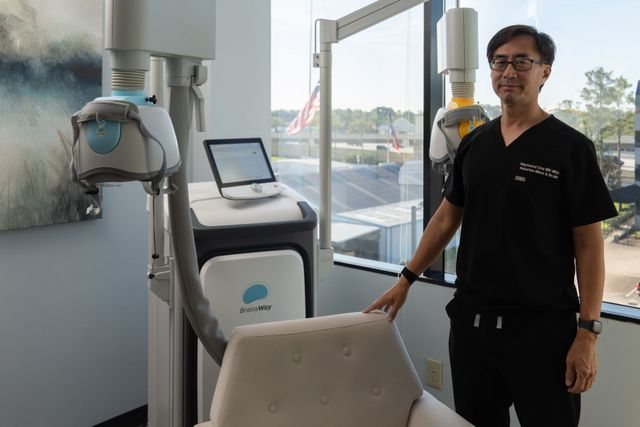
Houston Mind & Brain was founded by Dr. Raymond Cho, a psychiatrist with over 30 years of clinical and research experience in neurostimulation and brain-based treatments. Dr. Cho helped establish multiple major TMS programs in Houston and has received federal research funding for TMS.
Additionally, all Houston Mind & Brain TMS treaters are BrainsWay-certified and complete an additional in-house training program developed by Dr. Cho. Training includes education on the mechanisms of TMS, supervised observations, and hands-on practice under senior staff guidance. All treaters complete hundreds of hours of supervised training over at least three months before treating patients independently.
What's Different If You're Here for OCD
OCD is treated with a different Deep TMS coil that targets a different brain circuit than depression. It's FDA-cleared specifically for OCD, and not every TMS clinic offers it.
✓ FDA-cleared specifically for OCD
✓ A dedicated OCD coil aimed at the circuit involved in OCD
✓ We follow the symptom provocation protocol used in the original clinical trial
Common Questions About TMS for OCD
Is TMS FDA-approved for OCD?
TMS devices are FDA-cleared rather than approved; clearance is the regulatory pathway for this class of device. BrainsWay's Deep TMS system was cleared for adjunctive treatment of OCD in adults in 2018, the first non-invasive device cleared for the condition. Other systems have since been cleared on the basis of equivalence to that device rather than their own large OCD trials.
How is Deep TMS for OCD different from regular TMS?
Standard TMS for depression uses a figure-8 coil over the dorsolateral prefrontal cortex. Deep TMS for OCD uses the H7 coil, which targets the medial prefrontal and anterior cingulate cortices, and each session begins with symptom provocation. The coil, the target and the protocol all differ.
I tried TMS before and it didn't help my OCD. Could this be different?
Possibly. If your earlier course targeted the dorsolateral prefrontal cortex for depression, used a figure-8 coil or omitted symptom provocation, it was not the protocol studied for OCD. Bring your treatment records to your evaluation and we will tell you plainly whether another course is reasonable.
How long does TMS take to work for OCD?
In post-marketing data, first response occurred after an average of 18.5 sessions. Little change in the first two to three weeks is expected, which is why completing the full course matters.
Can TMS make OCD worse?
A transient increase in anxiety during a session is expected, because provocation deliberately brings on symptoms for a few minutes. That distress usually subsides after the session. If your symptoms feel worse during or between sessions, always tell your TMS treater or psychiatric provider, so they can talk through what is typical and adjust your care if needed.
Do I have to stop my OCD medication?
No. TMS for OCD is typically an adjunctive treatment, used alongside your current medication. Discuss any change with your prescriber first.
Does TMS replace exposure and response prevention (ERP)?
No. ERP remains the first-line psychotherapy for OCD. TMS is used alongside it, not in place of it.
Is this just a placebo effect?
It is a reasonable question for any procedure with a strong ritual component. The pivotal trial compared active treatment with a sham designed to feel similar, and active treatment did significantly better: a 38.1% response rate versus 11.1% at six weeks. Some patients do improve with sham, which is exactly why sham-controlled trials exist.
Medically reviewed by Raymond Cho, MD. Last updated October 2026.
References
- Carmi L, Tendler A, Bystritsky A, et al. Efficacy and safety of deep transcranial magnetic stimulation for obsessive-compulsive disorder. Am J Psychiatry. 2019;176(11):931-938.
- Roth Y, Tendler A, Arikan MK, et al. Real-world efficacy of deep TMS for obsessive-compulsive disorder. J Psychiatr Res. 2021;137:667-672.
- Bello D, Jones M, Gadiyar I, et al. Symptom provocation and clinical response to transcranial magnetic stimulation. JAMA Psychiatry. 2025;82(8):768-777.
I have greatly benefited from the services of Houston Mind & Brain. I would encourage anyone seeking neurological or psychiatric treatment to visit them. I have particularly benefited most from their TMS treatment. It has changed my life for the better in so many ways. They have knowledgeable and friendly staff and providers who really do care about your health and because they are a smaller office you really do get that personal connection with the providers and staff. Highly recommend!
Jessie
Comprehensive Psychiatric Care
Related Services

Integrated Care That Delivers Results
Research-informed care that integrates medication management, psychotherapy, TMS, and Spravato/ketamine into a coordinated treatment plan. Treatments are thoughtfully sequenced and monitored within a structured clinical model to support safety, consistency, and meaningful outcomes.
Why Choose Houston Mind & Brain?
MD-led, research-informed brain health - advanced treatments, personalized plans, and practical insurance support.
Insurance Help & Clear Pricing
30+ Years MD Led Psychiatry
Accelerated TMS & Fast Track Paths
Clinical Research & Outcomes Tracking
Integrated Treatment Options
Spravato, Ketamine & KAP Programs